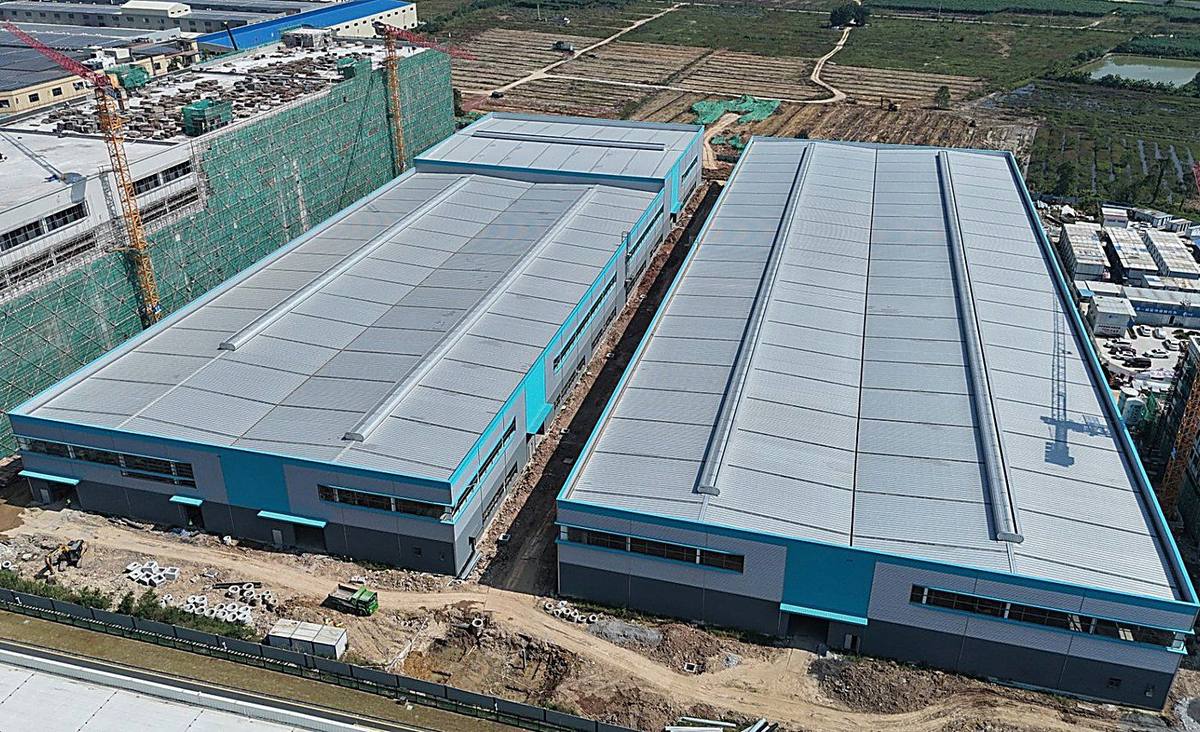
How Much Does a Steel Building Cost
Per Square Metre?
There is no single price. A steel building cost per m² is the sum of seven cost blocks — and once you know which block you are paying for, a quote becomes a conversation instead of a guessing game.
Every buyer asks for a price per square metre, and every supplier answers with a number. The problem is that a "price per m²" is meaningless on its own — a poultry shed in a mild climate and a cold store in a hot one can differ by a factor of three, yet both get quoted as "per square metre". This guide shows the seven cost blocks that make up the final figure, so you can see where your money goes and what you are actually paying for.
The seven cost blocks
Every steel building quote, from the simplest shed to a full production complex, is built from the same seven components. The proportions change; the structure does not.
| Cost block | What it covers | Typical share |
|---|---|---|
| 1. Primary steel frame | H-beam columns and rafters, brackets, base plates, anchor bolts | 30 – 40 % |
| 2. Secondary steel | C / Z purlins, wall girts, eave struts, bracing | 8 – 15 % |
| 3. Roof and wall cladding | Steel sheets or sandwich panels, flashings, gutters, downpipes | 15 – 25 % |
| 4. Doors, windows and openings | Roller doors, sectional doors, personnel doors, windows, louvres | 5 – 12 % |
| 5. Foundation and slab | Concrete footings, anchor bolts, floor slab, apron | 10 – 20 % |
| 6. Erection and transport | Assembly, lifting, sea freight, unloading, insurance | 8 – 15 % |
| 7. Finishes and extras | Coating, drainage, gutters, safety line, painting, site work | 5 – 10 % |
Shares are indicative for a single-storey portal-frame building in an export market. They shift with span, height, location and specification.
The four factors that move the price most
1. Span
Span is usually the biggest single driver. As span increases, the frame member weight grows faster than the floor area — so the cost per m² rises even though you are buying more usable space. A 12 m bay is efficient; an 18 m bay needs heavier rafters, deeper eaves and more bracing.
| Clear span | Frame intensity | Indicative cost index |
|---|---|---|
| 9 – 12 m | Light | Baseline (100) |
| 15 m | Moderate | 110 – 120 |
| 18 m | Heavy | 120 – 135 |
| 24 m | Very heavy, special trusses | 140 – 160 |
| 30 m and above | Specialist design, crane or hangar doors | 165 and above |
2. Height and clearances
Every extra metre of eave height costs more than the metre before it, because cladding, girts, bracing and wall area all grow. A 6 m eave warehouse and a 10 m eave warehouse are not priced on a straight line — the step from 6 m to 10 m costs noticeably more per square metre than the step from 4 m to 6 m.
3. Envelope specification
The single cheapest way to reduce a steel building cost is to change the envelope. A bare frame with a single steel sheet is the cheapest configuration; insulated sandwich panels, especially rock wool or PIR, add materially to the price. The panel core is where a large part of the cladding cost sits, and it is the one area where you can usually trade specification against budget without affecting the structure.
4. Location and codes
Wind, snow and seismic loads decide the section sizes. A site in a high seismic zone or a coastal typhoon area needs heavier steel, more bracing and different connection details. This is not a "premium" you can negotiate away — it is a code requirement, and the steel weight follows directly from it.
What specification changes the price by how much
| Choice | Effect on cost | When it makes sense |
|---|---|---|
| Single steel sheet vs insulated panel | Panel costs noticeably more, but cuts cooling load and running cost | Occupied, climate-controlled or food / cold chain |
| EPS vs rock wool vs PIR core | Rock wool and PIR cost more per m² than EPS | Rock wool for fire rating, PIR for cold rooms and best U-value |
| Z purlins vs C purlins | Z purlins reduce tonnage on long spans | Spans over 6 m or three-bay-and-up buildings |
| Standard mill colour vs RAL custom colour | Custom colour adds a small surcharge per m² | When appearance matters and volume justifies it |
| Hot-dip galvanised vs pre-painted | Pre-painted is usually the cheaper route | Standard building envelopes; galvanised for hidden steel |
| Sandwich panel vs wall sheet plus insulation | Comparable; panel is faster to erect | When labour is the constraint on site |
Why quotes for the same building differ so much
When you compare two quotes for the same footprint, the difference is rarely the steel. It is almost always one of these:
- Different steel grade — Q235 versus Q355 changes section sizes and tonnage
- Different coating — pre-painted versus hot-dip galvanised, and coating weight (Z120 / Z275 / Z350)
- Different load case — if one quote assumed a lower wind or snow load, it is not the same building
- Different scope — does it include anchor bolts, foundation drawings, erection, or delivery only to port?
- Different sheet thickness — 0.4 mm and 0.5 mm sheet look identical and price very differently
- Different terms — FOB, CIF and DDP are not comparable prices
Before comparing any two quotes, put them on the same basis. Ask each supplier for the same six items: steel grade, coating weight, sheet thickness, load case, scope list and trade term. Only then does the number mean something.
How to get a fast and accurate quote
- Send length × width × eave height and the intended use
- State the project location so the correct wind, snow and seismic loads are applied
- Say the span and bay layout if you have it — it changes the price more than anything else
- Specify the cladding — single sheet, or sandwich panel and which core
- List the openings — roller door sizes and quantity, personnel doors, windows
- Confirm the scope — supply only, or supply plus erection and local delivery
- State the trade term — FOB, CIF or DDP
- Give the quantity — a schedule or a total tonnage both work
With those eight items, a supplier can price a building accurately. Without them, any number is an estimate dressed up as a quote.
Frequently asked questions
For single-storey industrial, warehouse and agricultural buildings, steel is normally cheaper overall once you include foundation cost, because the frame is lighter and construction is faster. For multi-storey, high-rise or heavily fire-regulated buildings, concrete can still win on some measures.
For a typical single-storey portal frame, the frame plus secondary steel is around 40 to 55 % of the supply price. The rest is cladding, foundations, doors, erection and freight. That is why comparing steel price per tonne between suppliers rarely tells you which building is cheaper.
Usually yes, up to a point. Fixed costs — engineering, drawings, freight and mobilisation — spread over more area. Beyond roughly 5,000 m² the saving flattens out, and the site and local labour conditions start to matter more.
Most often excluded: concrete foundations and slabs, civil works, drainage, site clearance, permits, and local erection labour beyond the port. Always ask for an itemised scope so nothing important is assumed later.
Usually yes, and the first lever is the envelope, not the structure. Panel core selection, sheet thickness and the number and size of openings can be adjusted without touching the frame. Reducing the frame section below what the load case requires is not an option — that is a safety matter, not a saving.
Get an itemised steel building quote
Send your length, width, height and location. We come back with a cost breakdown by system — frame, purlins, cladding, doors and freight — so you can see exactly where the money goes.
Related guides
Color steel sheet thickness: 0.5, 0.6 or 0.8 mm
Base metal vs total thickness, tolerance bands and real section properties.
Read the guidePurlin span calculator
Turn a span and spacing into the lightest section that passes.
Open the calculatorC purlin vs Z purlin: which to specify?
How section shape decides your span, your tonnage and your fixing detail.
Read the guideSeven steel building product systems
Roofing, wall, purlins, panels, structure, hardware and doors from one supplier.
See the systemsC purlin range — C80 to C250
Section properties, mass and Ix/Wx tables for the profile that carries the roof.
See the C rangeZ purlin range — Z100 to Z300
Lapped continuous Z runs, and where they cut tonnage against a C line.
See the Z rangeHow to quote a steel building
The RFQ checklist, what a complete quotation must contain, and how to compare two offers.
Read the guideSandwich panel core comparison
EPS, rock wool, glass wool, PU and PIR compared on U-value and fire rating.
Read the guide