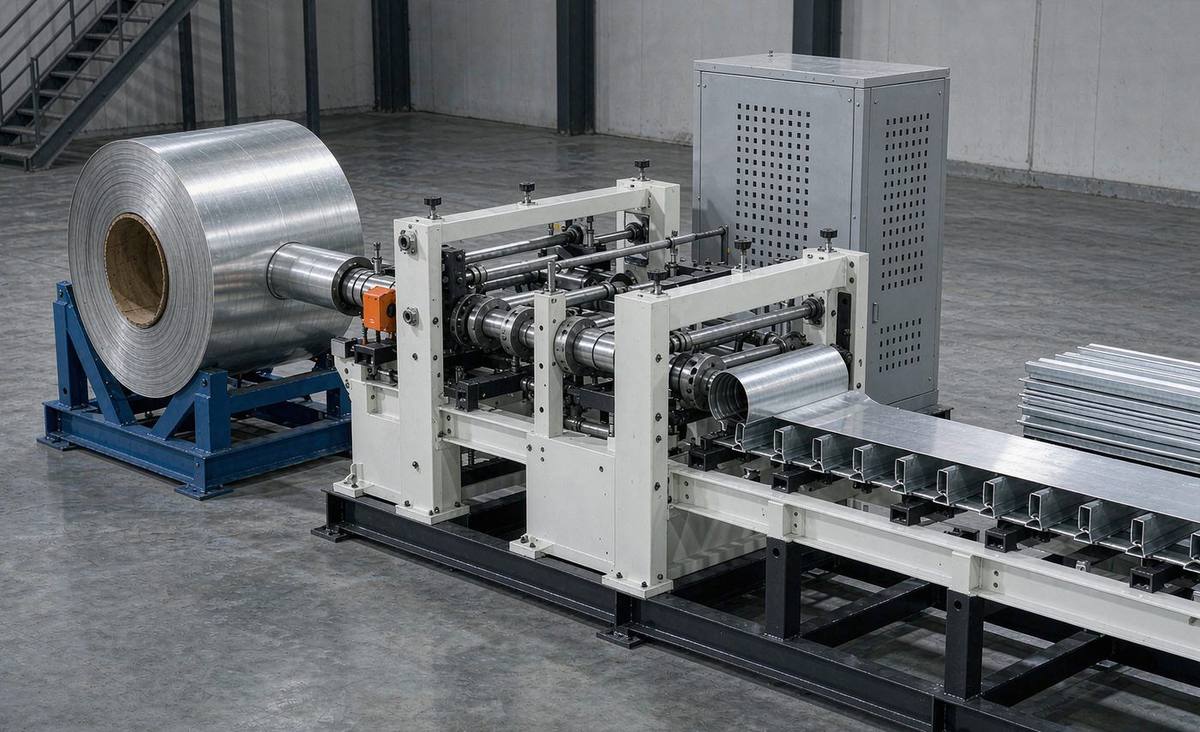
What a Z purlin is, and where it wins
A Z purlin is a cold-formed zed: a web of height h, two unequal flanges and a stiffening lip, with the flanges turned in opposite directions. That asymmetry is the whole point — successive purlins nest into each other at the supports, so a run of Z sections can be bolted into a continuous beam instead of a row of simple spans.
We roll ten Z heights from Z100 to Z300 in 2.0, 2.5 and 3.0 mm. Where a roof has a long uninterrupted run between frames, a lapped Z line usually needs a smaller section than the equivalent C line, because the lap carries hogging moment over the support and cuts mid-span deflection sharply.
Where a Z purlin is the right answer
- Long runs and multi-bay roofs. Lapping 10 to 15 percent of the span turns simple spans into a continuous beam, which is where the weight saving comes from.
- Frames at 7.5 m and beyond. Above roughly 6 m the C section that passes deflection gets heavy fast; a lapped Z line usually wins on tonnage.
- Transport and storage. Nested Z packs take roughly half the volume of the same run in flat-stacked C sections.
- Roof purlins specifically. For wall girts the lap rarely pays, and C is usually the cheaper answer there.
Z100 to Z300 · nominal dimensions
| Model | Web h | Flange b1 | Flange b2 | Lip c | Punching |
|---|---|---|---|---|---|
| Z100 | 100 | 55 | 50 | 20 | 40 mm |
| Z120 | 120 | 55 | 50 | 20 | Adjustable |
| Z140 | 140 | 55 | 50 | 20 | Adjustable |
| Z150 | 150 | 67 | 61 | 20 | Adjustable |
| Z160 | 160 | 67 | 61 | 20 | Adjustable |
| Z180 | 180 | 67 | 61 | 20 | Adjustable |
| Z200 | 200 | 67 | 61 | 20 | Adjustable |
| Z250 | 250 | 78 | 72 | 20 | Adjustable |
| Z280 | 280 | 78 | 72 | 20 | Adjustable |
| Z300 | 300 | 78 | 72 | 20 | Adjustable |
Punching is set to your drawing. “Adjustable” means hole diameter and spacing are made to order.
Mass, Ix, Wx and Iy for every thickness
| Model | Thickness mm | Mass kg/m | Ix cm⁴ | Wx cm³ | Iy cm⁴ |
|---|---|---|---|---|---|
| Z100 | 2.0 | 3.85 | 78.86 | 15.46 | 42.55 |
| Z100 | 2.5 | 4.81 | 97.57 | 19.13 | 53.55 |
| Z100 | 3.0 | 5.77 | 115.88 | 22.73 | 64.71 |
| Z120 | 2.0 | 4.16 | 120.54 | 19.72 | 42.56 |
| Z120 | 2.5 | 5.20 | 149.43 | 24.45 | 53.57 |
| Z120 | 3.0 | 6.24 | 177.84 | 29.10 | 64.73 |
| Z140 | 2.0 | 4.47 | 172.82 | 24.27 | 42.57 |
| Z140 | 2.5 | 5.59 | 214.54 | 30.13 | 53.58 |
| Z140 | 3.0 | 6.71 | 255.69 | 35.91 | 64.74 |
| Z150 | 2.0 | 4.99 | 228.34 | 29.89 | 69.54 |
| Z150 | 2.5 | 6.24 | 283.62 | 37.13 | 87.46 |
| Z150 | 3.0 | 7.49 | 338.19 | 44.27 | 105.61 |
| Z160 | 2.0 | 5.15 | 265.17 | 32.56 | 69.55 |
| Z160 | 2.5 | 6.44 | 329.53 | 40.46 | 87.47 |
| Z160 | 3.0 | 7.72 | 393.12 | 48.27 | 105.62 |
| Z180 | 2.0 | 5.46 | 348.76 | 38.10 | 69.56 |
| Z180 | 2.5 | 6.83 | 433.76 | 47.39 | 87.48 |
| Z180 | 3.0 | 8.20 | 517.89 | 56.58 | 105.64 |
| Z200 | 2.0 | 5.78 | 446.27 | 43.92 | 69.56 |
| Z200 | 2.5 | 7.22 | 555.39 | 54.66 | 87.50 |
| Z200 | 3.0 | 8.67 | 663.54 | 65.31 | 105.66 |
| Z250 | 2.0 | 6.91 | 823.87 | 65.03 | 103.74 |
| Z250 | 2.5 | 8.63 | 1026.40 | 81.02 | 130.42 |
| Z250 | 3.0 | 10.36 | 1227.56 | 96.90 | 157.40 |
| Z280 | 2.0 | 7.38 | 1076.55 | 75.93 | 103.76 |
| Z280 | 2.5 | 9.22 | 1341.81 | 94.65 | 130.43 |
| Z280 | 3.0 | 11.07 | 1605.54 | 113.25 | 157.42 |
| Z300 | 2.0 | 7.69 | 1268.33 | 83.54 | 103.76 |
| Z300 | 2.5 | 9.62 | 1581.26 | 104.15 | 130.44 |
| Z300 | 3.0 | 11.54 | 1892.53 | 124.66 | 157.43 |
Computed from the nominal dimensions for Q235 strip. The same values drive the online span calculator and the downloadable span tables.
How to size one
Four steps. The online calculator does all of them for the whole range in one pass.
Open the span calculatorSteel grade, coating and thickness
- Grade. Q235 / S235 is standard for purlins; Q355 / S355 is available where the design calls for it.
- Coating. Z275 galvanised is the normal export specification. Heavier coatings are worth specifying for coastal or high-humidity sites.
- Thickness. 2.0, 2.5 and 3.0 mm are the standard gauges in the tables above. Other gauges are quoted on request.
- Standard. Cold-formed sections to GB 50018; tolerances and hole positions confirmed on the approved drawing before rolling.
Punching, sag rods and cleats
Holes are punched to your layout or to our standard pattern, whichever you prefer — the dimension tables above show where a fixed pattern exists. Sag rods, cleats, sleeves and angle brackets are cut and drilled to match the same drawing, so a pack arrives ready to bolt rather than ready to modify.
Documentation and quality
Every shipment ships with mill test certificates, a packing list and a certificate of origin. The plants work to ISO 9001, ISO 14001 and ISO 45001, and copies of the certificates are available on request. Third-party pre-shipment inspection can be arranged if your buyer requires it.
Packing, loading and order quantity
Purlins are bundled and steel-strapped, with each bundle marked to the packing list so site can match it to the erection drawing.
We build the loading plan before packing: lengths, bundle count and the container mix are worked out together, because purlin bundles are what usually decide whether a 40HQ closes properly.
Order quantity depends on the section, the gauge and how the mill run is set up. Send the schedule — lengths, sections and total tonnage — and we will confirm what can be rolled together in one run.
Get a price on Z purlins
Send the section, gauge, lengths and total tonnage — or just the drawing. You get a priced offer with the packing and loading plan, normally within one working day.
C purlin questions we get asked
As a rule of thumb, 10 to 15 percent of the span, bolted through the nested flanges. The lap is what turns simple spans into a continuous beam, so it is worth getting right rather than trimming.
They can, but the lap rarely pays on a wall and the handedness makes fixing slower. C sections are usually cheaper and quicker for girts.
Yes. Because the flanges are unequal, successive purlins have to be turned 180° for the lap to nest. Check the orientation on the erection drawing before fixing — a run laid the same way round will not lap.
At that span a lapped Z line is usually the lighter answer, because continuity cuts mid-span deflection. Confirm with a calculation — or send us the loads and we will run both.