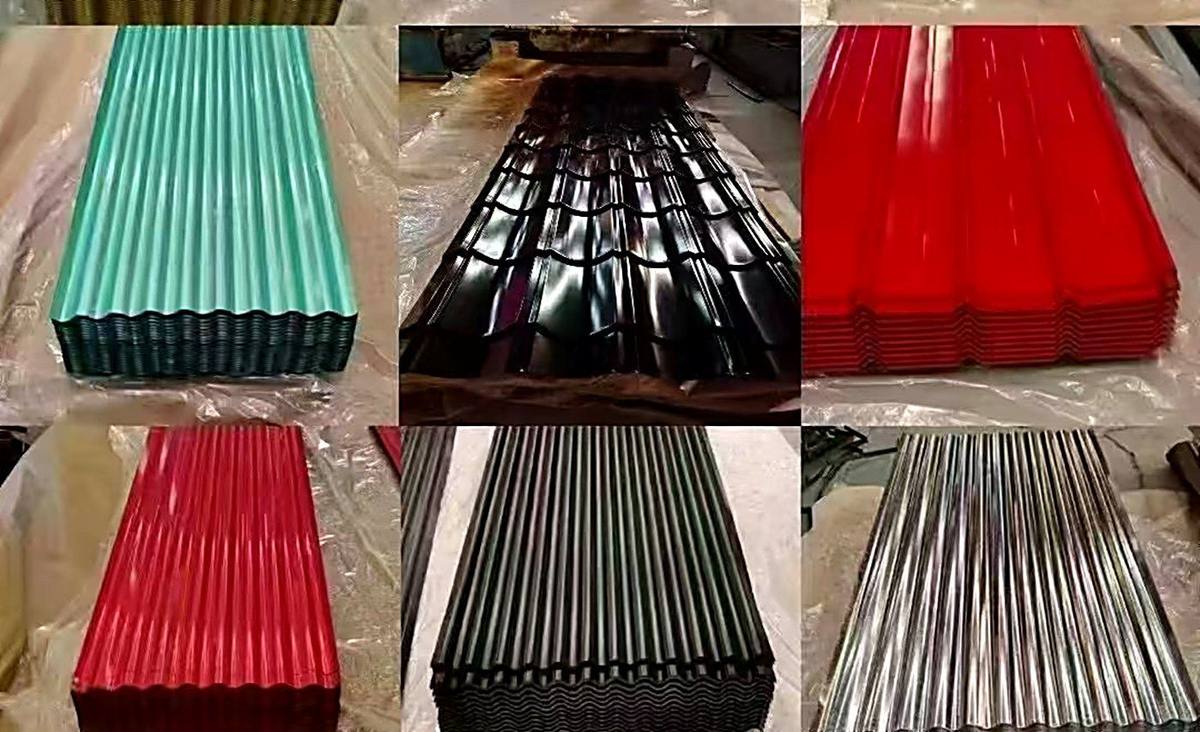
Color Steel Sheet Thickness:
0.5 mm, 0.6 mm or 0.8 mm — How to Specify It
The two thicknesses look identical on site. One is under-specified for your purlin spacing; the other is money you did not need to spend.
Colour steel sheet is not one material but a stack: a steel base, a metallic coating for corrosion protection, and a paint film for colour. Only the base steel carries load.
What color steel sheet thickness actually means
Two quotations can both say 0.6 mm and describe different products. One means base metal thickness — the steel that takes load. The other means total thickness, coating included. Comparing them is how buyers end up with a sheet thinner than they designed for.
The arithmetic explains it. A Z275 coating adds about 0.04 mm across both faces and a PE film another 0.04–0.05 mm, so a 0.6 mm base measures roughly 0.64 mm on a caliper and is still exactly what was ordered. Steel also carries a permitted negative tolerance — a sheet ordered as 0.5 mm can measure 0.46 mm and still comply — so the order should state the tolerance class and the measuring method.
Color steel sheet thickness tolerance: what to write in the order
Three standards cover most of what we export into, and their bands are close but not identical. Knowing which your supplier works to makes two quotations comparable.
| Standard | 0.40 mm | 0.50 mm | 0.60 mm | 0.80 mm | 1.00 mm |
|---|---|---|---|---|---|
| GB/T 2518-2019 (PT.A, ordinary) | ±0.04 | ±0.04 | ±0.05 | ±0.05 | ±0.06 |
| EN 10346 / EN 10143 (normal class) | ±0.04 | ±0.05 | ±0.05 | ±0.06 | ±0.07 |
| ASTM A653/A653M | ±0.05 | ±0.05 | ±0.05 | ±0.08 | ±0.08 |
Deviations in mm, for cold-rolled and coated flat products. GB/T 2518 also defines PT.B and PT.C precision classes, narrowing the band by roughly 30 % and 50 % against PT.A.
One allowance catches people out: the standards widen the deviation near the coil head and tail — roughly 50 % larger within about 30 m of the end, and about 60 % larger within 15 m of a weld.
How color steel sheet thickness changes the section properties
Thickness matters because it changes how the profile behaves. For cold-formed sheet the governing limits are stiffness and local buckling, not yield strength. Below are real section properties from our factory profile catalogue, for the same profile rolled at different thicknesses. I is the second moment of area (cm⁴/m) and W the section modulus (cm³/m).
| Profile (system) | 0.5 mm | 0.6 mm | 0.8 mm | 1.0 mm |
|---|---|---|---|---|
| YX114-333-666 (roof & wall) | 52.23 / 18.44 | 57.42 / 21.34 | 68.47 / 25.42 | — |
| YX65-300/400/430 (standing seam) | — | 27.50 / 17.65 | 42.12 / 20.38 | 53.16 / 27.69 |
| YX76-380-760 (concealed fix roof) | — | 37.27 / 12.29 | 46.69 / 16.39 | 62.11 / 20.46 |
| S-373 (concealed fix wall) | 8.10 / 4.50 | 11.10 / 5.20 | 13.76 / 6.60 | — |
Values read from our factory profile catalogue. A dash means that thickness is not rolled for that profile. Permissible span must be verified by a structural engineer against the actual loads.
Read the YX114 row: going from 0.5 to 0.8 mm lifts the moment of area from 52.23 to 68.47 — a gain of about 31 % for roughly 60 % more steel weight.
Which color steel sheet thickness to specify by application
The practical mapping for export work — indicative starting points, with the final call belonging to the engineer who holds your wind and snow figures.
| Application | Base thickness | Purlin spacing | Note |
|---|---|---|---|
| Permanent warehouse roof, mild climate | 0.5 mm | 1.0 – 1.2 m | Standard export spec |
| Permanent roof, heavy snow or wide bays | 0.6 mm | 1.2 – 1.5 m | The usual upgrade |
| Large span, coastal or high-wind site | 0.8 mm | 1.5 m | Check the span, not the gauge |
| Wall cladding, standard warehouse | 0.4 – 0.5 mm | ≤1.2 m | No snow load on a wall |
| Wall cladding, exposed site | 0.5 – 0.6 mm | ≤1.2 m | Handling damage first |
| Standing seam or concealed fix roof | 0.6 – 0.8 mm | 1.2 – 1.5 m | Seams need stiffness |
| Temporary shed or site hoarding | 0.3 – 0.4 mm | — | Buy for the job duration |
Indicative only. Purlin spacing of 1.2 – 1.5 m is normal for standard roofing sheet and insulated panel; thinner sheets, heavy snow and fragile cladding need closer spacing.
Three rules survive most projects. Roof sheet must be thicker than wall sheet on the same building, because the roof carries wind uplift, snow and foot traffic. Roof thickness and purlin spacing are one decision, not two.
What color steel sheet thickness costs per square metre
Colour steel is sold by weight, so thickness converts directly into money. At 7,850 kg/m³, one square metre of 0.5 mm sheet weighs 3.93 kg and 0.6 mm weighs 4.71 kg.
| Base thickness | Weight per m² | Against 0.5 mm | Typical use |
|---|---|---|---|
| 0.40 mm | 3.14 kg/m² | −0.79 kg | Liner and light wall sheeting |
| 0.50 mm | 3.93 kg/m² | baseline | The standard warehouse roof sheet |
| 0.60 mm | 4.71 kg/m² | +0.78 kg | Snow, wind, wider purlin spacing |
| 0.80 mm | 6.28 kg/m² | +2.35 kg | Coastal, large span, heavy snow |
Computed from a steel density of 7,850 kg/m³, base steel only. Galvanising and paint add a little on top — Z275 alone is 0.275 kg/m². Theoretical weight is what a mill certificate and a weighbridge compare against.
That 20 % difference is the whole argument in one line: 0.6 mm sheet costs about 20 % more per square metre than 0.5 mm sheet, because the price follows the tonne. When comparing two quotations, convert both to kg/m² first.
Frequently asked questions
Not for the same reason. Corrosion life is driven by coating mass and paint system, not base thickness, so in a mild inland climate a well-coated 0.5 mm sheet is a normal roof. Base thickness decides stiffness and uplift resistance.
No. Thickness adds stiffness, uplift resistance and impact tolerance, but also dead load and cost to every square metre. Past what your span needs, extra thickness is wasted money. In corrosive environments, coating beats gauge.
Measure base metal with a micrometer, at defined points along the coil, away from the sheared edge and outside the corrugation radius. Read head, middle, tail and both edges, then cross-check the theoretical weight on the mill certificate.
It should not, and usually does not. Thickness means the base steel, with the coating and paint film specified separately. That is why a 0.6 mm base sheet can measure 0.64 mm on a caliper.
0.6 mm is the usual starting point at a purlin spacing of 1.2 – 1.5 m, and 0.8 mm for heavy snow, wide spacing or an exposed site. It depends on your snow load and span, not on the country.
Send the building and the climate, get a thickness recommendation
Tell us the span, the purlin spacing, the location and whether people walk on the roof — and we will come back with the profile, thickness, section properties and a coating recommendation, with the price beside it.
Related guides
C purlin vs Z purlin: which to specify?
How section shape decides your span and tonnage.
Read the guideSandwich panel core comparison
EPS, rock wool, PU and PIR on U-value and fire rating.
Read the guidePurlin span calculator
Get the lightest section that passes both checks.
Open the calculatorHow much does a steel building cost per m²?
The seven cost blocks behind any steel building price.
Read the guide