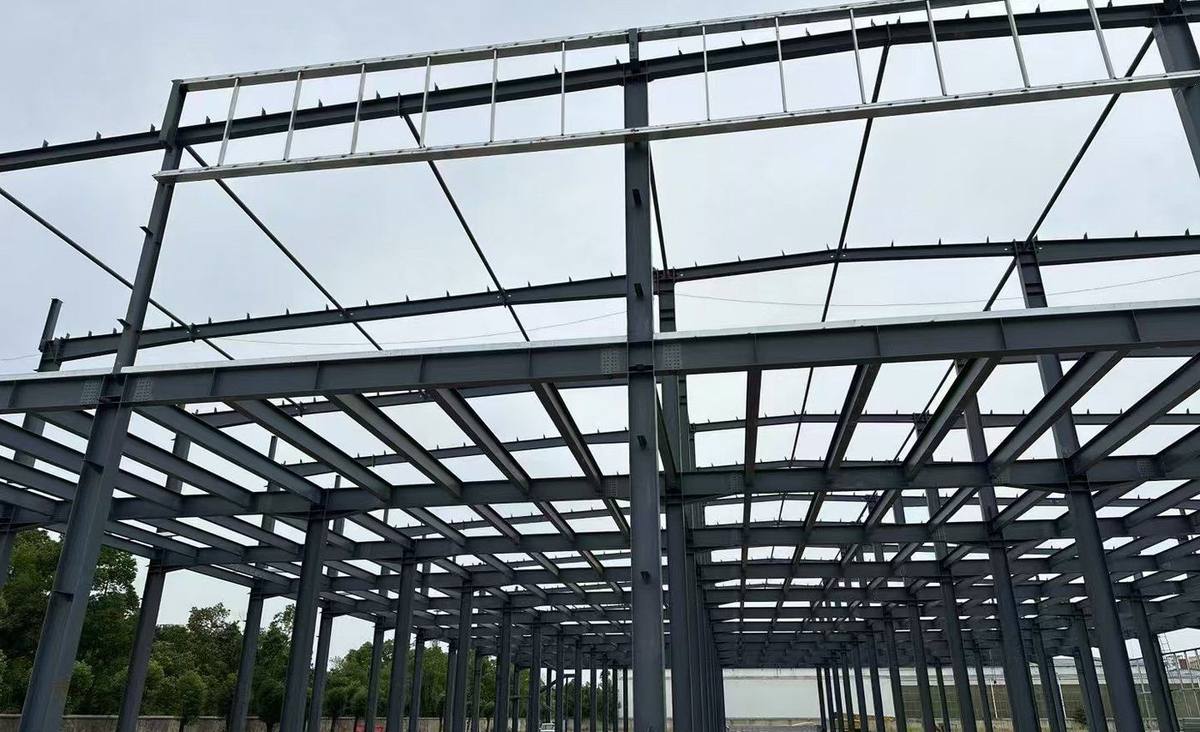
How to Quote a Steel Building
What to Send, What You Get Back
A quote is only as accurate as the brief behind it. Here is what a factory needs, what a complete quotation must contain, and how to compare two offers fairly.
Every factory answers within a day — but a number without a brief is not a quotation, it is an estimate with a safety margin built in. Where the brief is missing, the factory assumes, and you pay.
What information do you need to quote a steel building?
You do not need finished drawings, and you do not need to calculate wind or snow loads. You need to fix six things: footprint, height, site, openings, envelope, delivery.
Mark anything you are unsure about as to be confirmed — a named open question tells the engineer which assumption he may make.
| Information | What to send | Why it moves the price |
|---|---|---|
| Footprint and use | Length × width × eave height, and the intended use | Use sets loads, doors, fire |
| Span and column grid | Clear span, bay spacing, single or multi-span | Span and height drive size, tonnage |
| Site and code | City or region, local code if known | Wind, snow, seismic inputs come from location |
| Openings | Roller door sizes and count, personnel doors, windows | Each opening adds steel, changes frame |
| Crane or mezzanine | Crane capacity, hook height, span; mezzanine area | Runway beams, heavier columns — biggest add-on |
| Envelope | Single sheet or sandwich panel, core, colour | A large share of price, drives dead load |
| Quantity, timing, budget | Number of buildings or tonnage, delivery window, budget | Batch size, booking, container plan, scope |
| Delivery scope | Supply only or erection support, delivery point, term | Supply-only and supply-and-erect differ |
One page is enough for a first package quote. Drawings and a bill of quantities tighten the price but are not required.
How a factory turns your brief into a steel building quote
A quotation is not a single calculation but the output of a short engineering chain: the brief is reviewed, the design basis fixed from the local code loads, the layout settled, the sections sized and taken off, and the price built up system by system. Every link produces a visible output — a general arrangement drawing, a section schedule, a tonnage breakdown — so you can check the quote.
Two behaviours reveal the supplier. A factory that asks for the site and the openings before it prices is protecting the design. One that quotes without asking a single question is padding the price with an allowance — and an allowance is paid twice: in the quote, again on the change order.
What a complete steel building quotation must contain
A useful quotation defines what will be designed, fabricated, delivered and installed — and what will not. If an item is not mentioned, it is excluded.
| Item | What the quotation should state |
|---|---|
| Engineering and design basis | Who designs, which code and loads apply, which drawings are issued |
| Primary steel | Grade, section sizes, quantity basis (theoretical, take-off, measured) |
| Secondary steel and hardware | Purlin and girt sections, spacing, coating; bolt grade, anchor bolts |
| Coating and corrosion protection | Pre-painted or galvanised, coating weight, surface prep, paint |
| Cladding, insulation, flashings | Sheet or panel, thickness, core, colour, gutters, flashings |
| Openings | Every door, window, louvre and roof opening, sizes and counts |
| Packing and freight | Packing and nesting method, container mix, delivery point, term |
| Erection and site work | Whether erection, unloading and site labour are included, and what is not |
| Documentation | Packing list, certificate of origin, mill test certificates |
| Commercial terms | Currency, validity, payment milestones, exclusions, change price |
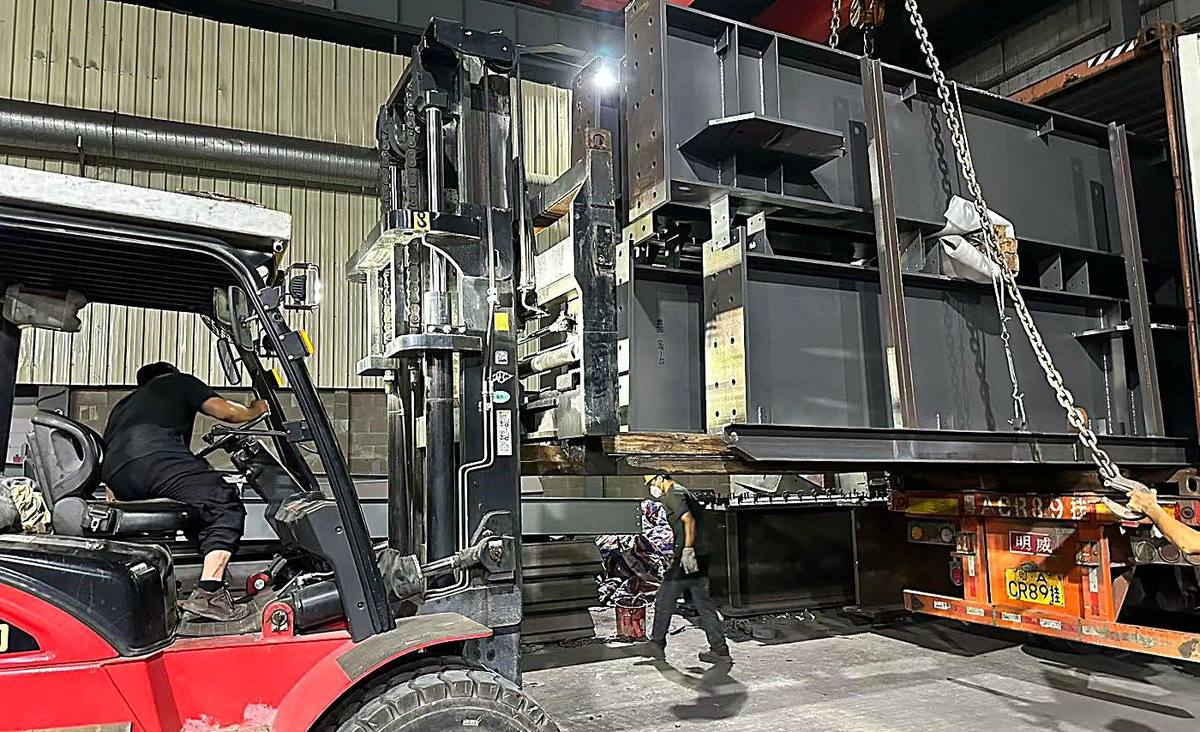
A package covering both structure and envelope should arrive as one set. We run the structural plant and the colour steel, purlin and panel plant in Foshan, so one material list, one QC standard and one container plan cover both. ISO certificates on request.
Indicative steel weight per m²: the number behind a steel building quote
Before any price arrives, sanity-check an offer against the weight it implies. Frame weight per square metre is hard to hide and moves predictably with span, crane and load case. If two quotations imply very different weights, one describes a different building.
| Building type | Span and configuration | Indicative weight |
|---|---|---|
| Agricultural / poultry shed | Wide span, light sheet cladding | 18 – 25 kg/m² |
| Light warehouse | 9 – 12 m span, single slope | 25 – 35 kg/m² |
| Standard workshop | 15 – 18 m span, no crane | 35 – 45 kg/m² |
| Cold store / controlled space | Insulated envelope, higher dead load | 40 – 50 kg/m² |
| Workshop with overhead crane | 5 – 10 t EOT crane, runway beams | 45 – 60 kg/m² |
| Multi-bay factory | 6 – 7.5 m bays, continuous run | 50 – 65 kg/m² |
Reference values only — typical order of magnitude for a single-storey portal frame, covering primary steel, purlins and bracing, excluding foundations and cladding. Not a design: final sections must be verified by a structural engineer against your actual wind, snow and seismic loads and deflection limits.
How to compare two steel building quotes on the same basis
Two quotations for the same footprint can differ widely without either being wrong — they are priced against two different buildings. Put both on the same basis.
- Same drawing revision and load case — which revision each price uses, and which wind, snow and seismic inputs applied
- Same steel grade and coating — Q235 versus Q355 changes sections and tonnage; pre-painted or galvanised, and coating weight (Z120 / Z275 / Z350)
- Same sheet thickness and panel core — 0.4 mm and 0.5 mm sheet look identical and price very differently; EPS, rock wool and PU/PIR do not price alike
- Same scope and weight basis — anchor bolts, erection, delivery point, and whether tonnage is theoretical, an agreed take-off or measured
- Same commercial terms — currency, Incoterm, validity, payment milestones
Send the same one-page brief to every factory and ask for the same columns back. Identical inputs turn three interpretations of your project into three comparable numbers. Check the validity date: steel and freight move, so an offer holds only for a defined period — confirm it in writing and decide inside it.
Frequently asked questions
Six blocks: footprint, intended use, site location, openings and equipment, envelope preference, and delivery scope with quantity. One page is enough; drawings or a bill of quantities tighten the price but are not required.
No. Dimensions and a simple sketch are enough for a first package quotation. Shop drawings come after the design is agreed, well after the first price. If you have architectural drawings, send them — they save a question.
An offer is valid for a defined period, because steel and freight prices move. Ask for the validity date in writing. We do not fix a delivery date inside the quotation: timing follows drawing approval and material availability.
Ask for both, but rely on the itemised one. A price per m² is a shortlisting tool; the itemised breakdown tells you whether two offers describe the same building. Narrow the list on the per m² figure, decide on the items.
Most often excluded: foundations and slabs, civil and drainage works, site clearance, permits and approvals, and local erection labour beyond the delivery point. Crane supply, HVAC, electrical and fit-out are separate. Ask for an exclusions list in writing.
Send the brief, get an itemised quotation
Send your length, width, eave height, site and openings — or use the BOQ template on our downloads page — and our engineering team returns an itemised quotation within 24 hours. FOB, CIF and DDP.
Related guides
Color steel sheet thickness: 0.5, 0.6 or 0.8 mm
Base metal vs total thickness, tolerance bands and real section properties.
Read the guideRoofing Profile Catalogue
22 profiles with the section data at every rolled thickness.
Request the catalogueHow much does a steel building cost per m²?
The seven cost blocks behind any steel building price.
Read the guideC purlin vs Z purlin: which to specify?
How section shape decides your span and tonnage.
Read the guideSandwich panel core comparison
EPS, rock wool, glass wool, PU and PIR compared on U-value and fire rating.
Read the guideC purlin range — C80 to C250
What to put in a purlin schedule, and the section data that backs it.
See the C range